
In 2026, content creation looks completely different from what it was just a few years ago. Artificial Intelligence tools can now generate blog posts, write ad copies, create video scripts, design graphics, and even produce voiceovers within seconds. Platforms powered by OpenAI, Jasper, and Copy.ai have become part of everyday marketing workflows.
But this raises a powerful question:
Is AI replacing human creativity — or simply reshaping it?
Let’s break it down.
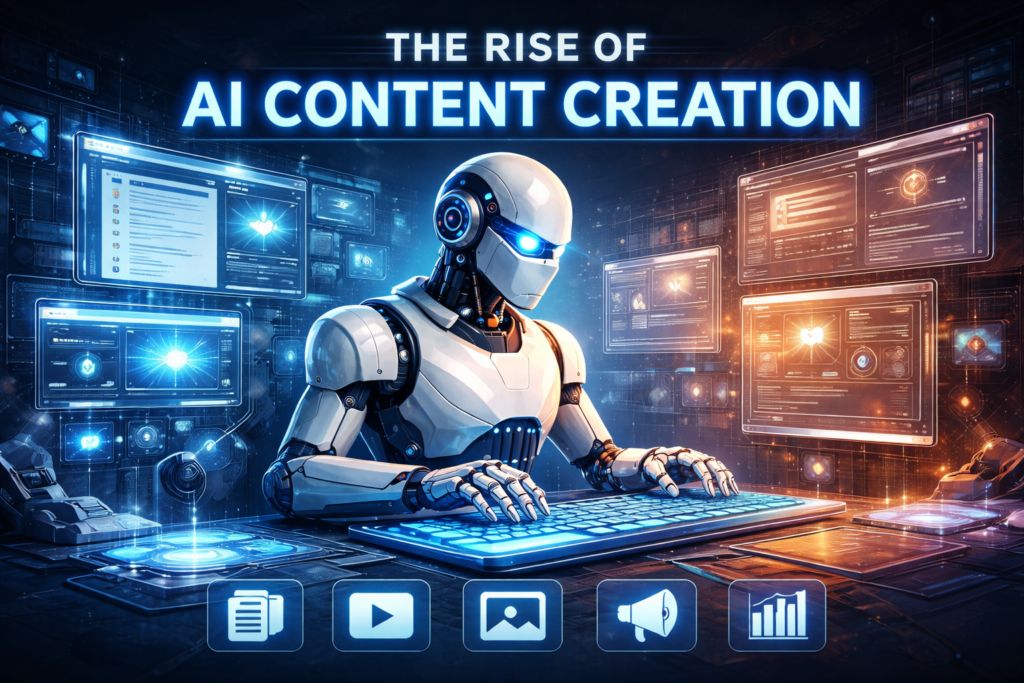
The Rise of AI Content Creation
AI content tools are built on large language models trained on vast amounts of internet data. They can analyze patterns, understand context, and generate human-like responses in seconds. For businesses and marketers, this has unlocked massive advantages:
- Faster content production
- Reduced operational costs
- 24/7 scalability
- Data-driven optimization
For example, instead of spending three hours drafting ad copies, marketers can now generate 20 variations in minutes and test them instantly. AI can also analyze which headlines perform better based on engagement metrics.
In short, AI is incredibly efficient.
But efficiency is not the same as creativity.
What AI Does Exceptionally Well
AI thrives in structured, repetitive, and data-heavy tasks. It excels at:
1. Speed and Volume
Need 50 product descriptions? AI can deliver them instantly.
2. SEO Optimization
AI can structure content using keywords, semantic phrases, and formatting best practices.
3. A/B Testing
It can quickly generate multiple ad copies for platforms like Meta and Google Ads to test performance.
4. Idea Generation
Content blocks? AI can brainstorm topics, outlines, and hooks.
For digital marketers, this means productivity has multiplied. Agencies now serve more clients without increasing team size. Freelancers deliver faster. Brands maintain content consistency across platforms like Instagram and YouTube.
Clearly, AI is powerful.
But here’s the twist.
Where Human Creativity Still Wins
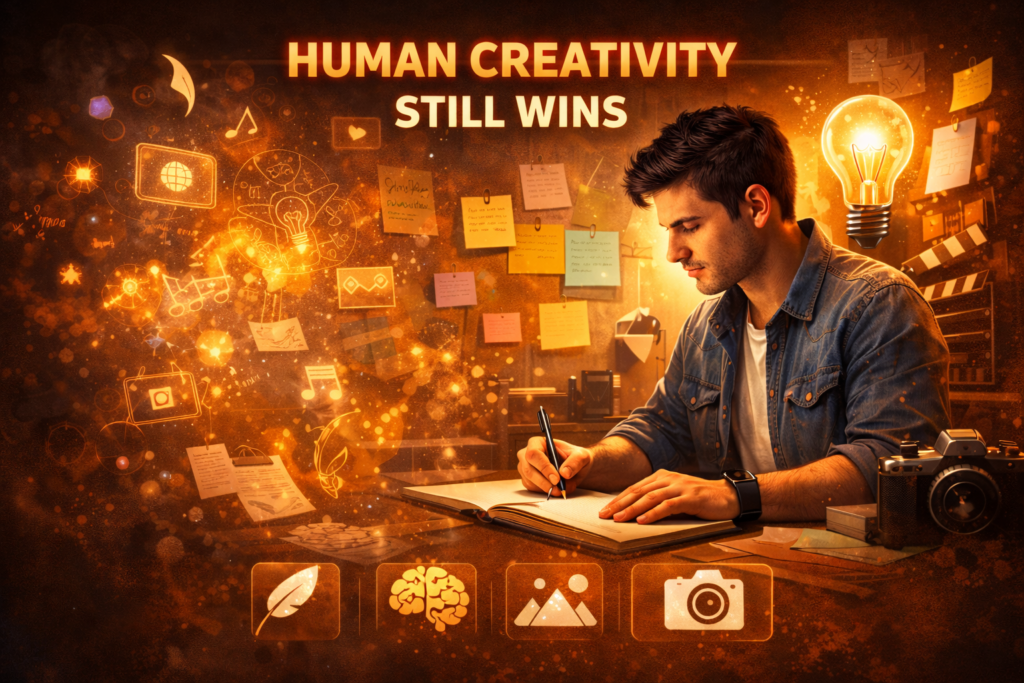
Despite its intelligence, AI lacks lived experience, emotion, intuition, and originality in the true sense.
Human creativity is fueled by:
- Personal struggles
- Cultural understanding
- Emotional depth
- Real-world experiences
- Unpredictable imagination
AI generates content based on patterns. Humans create based on meaning.
For example, AI can write a motivational speech. But it cannot genuinely feel failure, heartbreak, ambition, or resilience. When a human creator shares a personal story, it resonates because it is authentic.
Emotion is the currency of content.
And authenticity is hard to automate.
The Real Battle: Replacement or Collaboration?
The biggest misconception is that AI and human creativity are competitors.
In reality, the winners in 2026 are those who combine both.
Think of AI as a super-powered assistant:
- It handles research
- It structures drafts
- It suggests improvements
- It analyzes performance
Meanwhile, humans:
- Refine the narrative
- Add personal storytelling
- Inject brand personality
- Make strategic decisions
AI can generate a blog outline. But a human decides the tone.
AI can draft a caption. But a human understands the audience psychology behind it.
The smartest marketers don’t ask, “Who wins?”
They ask, “How do I use AI to amplify my creativity?”
The Risk of Over-Reliance on AI
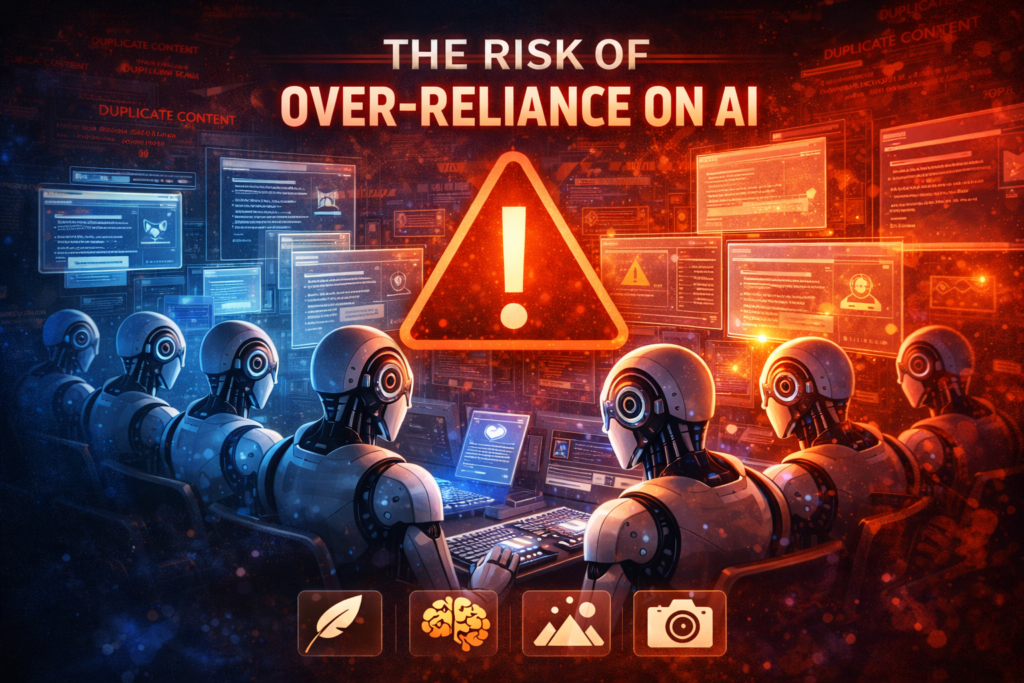
There is also a hidden danger.
As more businesses rely solely on AI-generated content, the internet risks becoming repetitive. Similar tones. Similar structures. Similar phrasing.
If everyone uses the same tools without personalization, differentiation disappears.
Search engines and AI-driven platforms are evolving to detect low-effort, generic content. Even Google continues to emphasize helpful, experience-driven content in its ranking systems.
This means content that lacks originality may struggle in the long run.
In 2026, content that stands out will not be the fastest content — it will be the most human content.
Creativity in the Age of AI
The definition of creativity is evolving.
Earlier, creativity meant writing everything from scratch. Today, it means:
- Knowing what to automate
- Knowing what to personalize
- Knowing how to think strategically
- Knowing how to guide AI effectively
Prompt engineering itself has become a creative skill. The better your instructions, the better your output.
So in a way, AI hasn’t reduced creativity.
It has raised the bar.
Average content creators who rely blindly on AI will blend into the noise. Strategic creators who use AI intelligently will scale faster than ever before.
Who Actually Wins?
The answer is simple:
AI wins in speed.
Humans win in emotion.
But the real winner is collaboration.
AI cannot replace imagination rooted in human experience. However, humans who refuse to adapt to AI tools risk falling behind.
In 2026, the most successful digital marketers are not those who fear AI — and not those who depend on it blindly.
They are the ones who master it.
Final Thoughts
AI content creation is not the end of human creativity. It is an evolution of it.
The future belongs to creators who:
- Use AI for efficiency
- Use data for decisions
- Use storytelling for connection
- Use authenticity for trust
Technology changes. Human emotion does not.
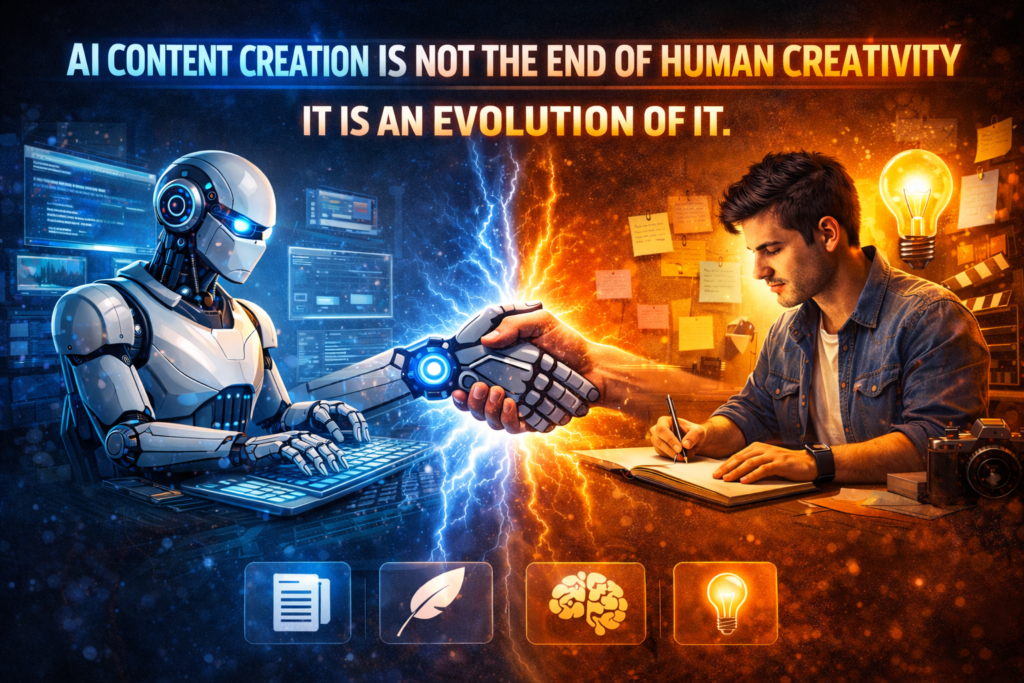
And as long as people connect through stories, creativity will always need a human touch.
So who wins?
Not AI.
Not humans alone.
The winner is the creator who learns to blend both intelligently. 🚀